Remote Pool Monitoring: What’s Actually Worth Monitoring?
There’s a lot you can monitor remotely on a swimming pool these days. The question is: how much of it do you actually need?
We’re all for technology at Pool Tech. If it makes a pool easier to manage, gives us better information or helps us spot a problem before it turns into a bigger one, then it absolutely has its place.But we’re also big believers in keeping things practical.
Because having a dashboard showing you 50 different readings doesn’t necessarily mean you know more about what’s happening with your pool.
So, what’s actually worth monitoring?
For us, it comes down to the things that tell you something useful about how the pool and plant are operating.
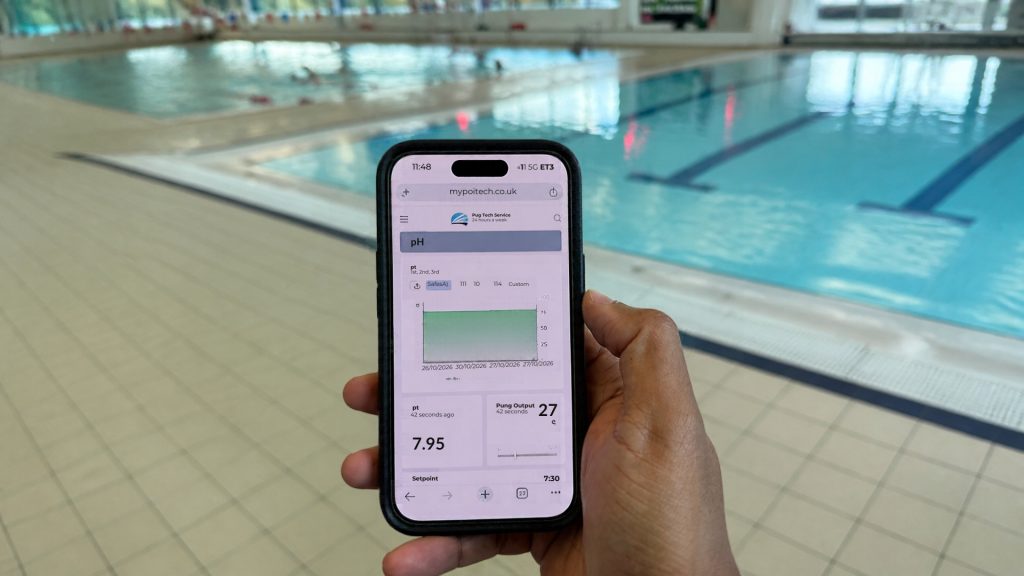
Water treatment parameters such as chlorine and pH are an obvious starting point. Depending on the system, you can also monitor things like circulation, flow rate, temperature, pressure gauges, balance tank levels, equipment status and faults. That information can be really valuable, particularly on sites where the plant room isn’t constantly manned. But there needs to be a reason for monitoring it.
If a reading changes, does somebody know what that means? More importantly, do they know what to do about it? Because collecting data for the sake of collecting data doesn’t achieve much.
The same goes for alarms
An alarm is only useful if somebody takes notice of it.
Set alerts for everything and you’ll very quickly end up with people ignoring them. We’d much rather have a smaller number of meaningful alarms that tell us something genuinely needs looking at. That might be a water parameter moving outside its normal range, a circulation issue or a piece of equipment reporting a fault.
The important thing is getting the right information early enough to investigate.
Can remote monitoring stop breakdowns?
Sometimes it can help you get ahead of them.
It isn’t a crystal ball, and it won’t prevent every breakdown, but changes in readings or equipment performance can be an early sign that something isn’t right. If we can see that remotely and get somebody to investigate before the problem gets worse, that’s where monitoring earns its keep.
Catching something early could mean a straightforward repair rather than a pool being out of action.
But someone still needs to walk into the plant room
This is where we think it’s important not to get carried away with technology.
You can’t manage a commercial swimming pool entirely from a laptop. A sensor can give you a reading. It can’t necessarily tell you there’s a small leak starting, something sounds different, a pump is vibrating more than it should or something just doesn’t look right. And anyone who has spent enough time in plant rooms will tell you that sometimes you know there’s a problem before a dashboard does.
Remote monitoring should support regular inspections, testing and maintenance – not replace them.
Who is remote monitoring actually for?
There’s also the question of who gets the most benefit from remote monitoring – the operator or the maintenance company?
For operators managing multiple sites, such as gym and health club groups or facilities management companies, the benefits are fairly obvious. Having a central team able to see what’s happening across several pools without physically being on every site can make managing those facilities much easier. If something starts moving outside its normal parameters, they’ve got visibility of it and can act.
But there’s a strong argument that remote monitoring can be just as useful for the maintenance company.
If we have access to the right information, we can potentially look at a fault remotely, see what the plant is doing and offer technical support before sending an engineer out. In some cases, that might be enough to resolve the problem there and then. In others, it means that if we do need to attend site, we already have a much better idea of what we’re walking into.
And that raises another question: should remote monitoring eventually become part of a pool maintenance contract?
There’s certainly an argument for it. If remote access allows maintenance companies to spot problems earlier, provide better technical support and potentially avoid unnecessary chargeable call-outs, it starts to become less of an optional extra and more of a useful part of looking after the plant.
It won’t be right for every pool or every contract, but it’s definitely something we think the industry will be talking about more.
When does it become overkill?
When you’ve got more information than anyone knows what to do with.
We’ve always taken a fairly simple approach at Pool Tech: use technology where it genuinely makes things better. We don’t need every available feature just because it exists. We need the right information, sensible alarms and people who understand what they’re looking at.
Every pool is different, so what’s worth monitoring will be different too. The plant, the facility, how the pool is used and who is responsible for looking after it all need to be considered.
Remote monitoring can be a brilliant tool. But ultimately, it’s still a tool!
And a good engineer who knows the plant, knows the site and knows when something isn’t right is pretty difficult to replace.
If you want to talk about remote monitoring or whether your current setup is giving you the information you actually need, speak to the Pool Tech team on 01204 410903.